Training instead of demonstrating

I often get the question during a training session, "can you show me.".

I often see the following happen.
People who can perfectly imitate what they have been taught...., but get stuck as soon as the situation is just a little different.

And that is exactly why I believe so strongly in real training.

You can show someone everything. In detail. Just like a navigation system, after you enter your destination, it takes you step by step to your destination. Mist you stick to the prescribed route.

But fair?
Then you reached the destination but you didn't learn the way. Next time, you again depend on your navigation system to arrive properly.

Learning and development

For me, learning works differently.

I think of good training as an itinerary on a piece of paper. On it are the most important points:

That route gives direction but leaves room.
Space for self-discovery.
Space to think about choices.
Space to learn the way.

A moment that for me sums up everything

At the start of a new training we did a round of introductions. One of the participants said very openly:

“I've had this kind of training so many times.
I don't actually understand why I'm here.”

I sincerely thanked her for her honesty. And I invited her to take the training from her expertise.

“If you have knowledge or experience that is valuable to the group,
share those above all.”

Not defensive. Not convincing. But with space and confidence.

Later that morning, a question came from the group. A participant kept running into the same situation when interacting with another person and was visibly frustrated.
No matter what he tried, it didn't work.

I deliberately put the question to the participant who had previously indicated he already knew everything.

The solution she offered was logical ..., but not helpful to the questioner.
“I already tried that,” he said.” he indicated. “And it has no effect.”

And that's exactly where the learning point arose.

Learning to choose instead of repeating

I used this moment to explain Stephen Covey's Circle of Influence and Engagement. Not to transmit theory, but to open a different perspective.

I showed that you do not increase your influence on another person by continuing to do what you always did, but by consciously choosing how you enter the contact.

If option one doesn't work, then it requires a different choice. A different approach.

For several participants, including those who already knew everything, this was a new insight. We discussed examples. We explored alternatives. And then we put the brought in case back to the group with one question:

What other choice can you make?

The effect

Some time later I received a call. By the participant who had said at the start that she already knew everything.

She told me that after the training she made a conscious decision to actively apply what she had learned. That she stepped differently in contact with others and approached difficult situations from a new perspective. She experienced the effect and had increased her influence. I was thrilled to hear that it had brought her a lot in the meantime.

That, to me, is what training is about.

Not knowing about it,
but about choosing.
Not about sending,
but about discovery.

The trainer as backup, not helmsman

This is how I work.

You drive yourself, I watch.
I ask questions, and you make choices.

And when the route feels familiar and you can travel it naturally, yourself go on your way. And after some time, this question follows:

What is the next path we can take?

Because when routes are familiar you don't learn anything new. In contrast, when you explore new routes you gain new experience and knowledge.

My approach

At the SalesCenter is not about tricks or standard solutions.
Bottom Line:

In this way, you avoid snapshot and lay the pathway for permanent impact.

Why people choose me:

✔️ Personalized and safe learning environment

✔️ Immediately applicable in your own practice

✔️ Room for experience and new insights

✔️ More influence through better choices

✔️ Trainer as sparring partner

✔️ Growth that stays, even after training

Anthon Geersing Sales trainer, make a sales team topper, grow in sales, sales in Amersfoort, zzp training in sales, mkb sales training

Do you also want to stop what gets in the way of results and get started on what makes a difference on your route?

If so, I'd be happy to go out for a bit with you.

Send me a WhatsApp message with your challenge and let's see together how to find another route in that.

Now on the road together

Schedule an appointment directly in my calendar here
Making an appointment

The right mindset when making acquisitions: tips for successful and positive calling

The right mindset in acquisition is the key to success.It is essential how you approach new clients positively, motivated and effectively.

Yet making acquisitions is a mental challenge for many salespeople. Maybe the marketing department has come up with a promotion that forces you to make calls. Or maybe you find yourself not wanting to depend entirely on incoming leads. Being active in sales is a must, and that includes acquisition.

Keeping existing clients warm and enthusing new potential clients are crucial parts of your job. But especially the latter - cold acquisition - is often difficult. Because who is really waiting for your phone call?

Dealing with rejections, silence or vague responses can be frustrating. Yet it is possible to do acquisition with a positive mindset. In this article, you'll discover practical tips for staying motivated and achieving greater success while making calls.

Why making acquisitions is often a challenge

By approaching acquisition with the right mindset, you make this process not only more effective but also more fun.

The right mindset in acquisition

1. See every interaction as an opportunity

Even a short phone call or a standard text message response is an opportunity to improve your message or build a relationship. Use the feedback you get to refine your approach.
As in the article Deal effectively with acquisition! is emphasized: “When you add variety to your approach, the likelihood of success increases.” You cannot change your client, but you can change your own behavior and approach.

2. Always remain professional

Even if a prospect never responds, it is important to remain professional and respectful. You never know if that same person will still show interest or recommend you to others in the future.
Avoid expressing disappointment in your emails, messages or conversations.

3. Focus on long-term relationships

Sales is not just about quick deals, but more importantly about trust and relationships. Through a consistent, polite and empathetic approach, you build a reputation that opens doors.
Consider:

In this way, you nurture the balance of trust - an essential starting point for a lasting business relationship.

When you vary your approach, the chances of success increase

How do you stay positive during calls?

  • Prepare well: Create a call script, but stay flexible.
  • Set a goal per conversation: that doesn't always have to be an appointment, it can also be getting information.
  • Celebrate small successes: every good interaction gets you closer to a deal.
  • Keep learning: Evaluate conversations and improve your approach each time.
make acquisitions, cold acquisition, mindset in acquisition, positive mindset during acquisition, positive calling, successful calling for sales, dealing with rejection in acquisition, acquire customers, call prospects, make sales calls, build valuable connections

Conclusion: making acquisition more fun and successful

Acquisition is a process that requires patience, creativity and perseverance. Dealing with no hearing and default responses is challenging, but with the right strategies and mindset, you can approach this process positively.

By focusing on persistence, respect and relationship building, you not only increase your chances of success, but also strengthen your professional reputation.

Remember: every interaction is one step closer to a valuable connection.

Ready to make acquisition more fun?

Want more tips on how to build really valuable connections in addition to acquisition?
Send me a email or WhatsApp message and schedule a free introductory consultation right away.

Also improving in acquisition?

Schedule an appointment directly in my calendar here
Making an appointment

Becoming a business friend: the commercial skills to build lasting relationships

If you have the traits of a business friend, you have important commercial skills that will make a difference in the long run.

Building business relationships is an art that goes beyond simply selling. A true business friend, as many call it, is not only a salesperson but also a trusted partner who guides, supports and inspires customers. In this article, we will take a closer look at how to become such a business friend and what commercial skills are essential to do so.

What is a business friend?

A business friend is more than a salesperson; this person puts the customer first and strives for a long-term relationship based on trust and mutual understanding. This type of salesperson understands the customer's needs and actively seeks solutions that add real value, rather than just offering products and services. This involves a combination of commercial acumen and empathy, which creates a solid foundation for a lasting partnership.

Essential commercial skills

To become a successful business friend, there are five core skills you must master. These are the foundation of a customer-centric and effective approach.

Customer Focus

Customer focus is the foundation of any business relationship. To be a business friend, you must not only understand the customer's needs and wants, but also anticipate what that person needs. Listening plays a crucial role in this. Ask pointed questions and show genuine interest in the client's challenges and aspirations. By placing your focus on delivering solutions that align with their goals, you create satisfaction and trust.

Self-Knowledge

Self-knowledge is an important and often underrated skill. The ability to recognize your own strengths and weaknesses enables you to communicate authentically and effectively. Reflect regularly on your performance and ask yourself how you can improve yourself. For example, are you good at persuasion but less skilled at listening? If so, work on strengthening your listening skills. Someone with the skills of business friend is always engaged in personal growth and uses that knowledge to become better at helping clients.

Collaborate

Collaboration is essential, not only within a team but also with clients. Building a partnership requires being open to input from others and being willing to look for solutions together. A business friend understands that success depends on internal collaboration as well as external partners. By ensuring transparency and respectful communication, you create an environment where collaboration flourishes.

Involvement

Engagement means that you are fully committed to your client's success. This goes beyond just executing transactions; you are a partner in their growth and development. Show that your commitment does not depend on the size of the deal, but on the value you add. A proactive attitude and checking in with the client regularly shows that you care about them and take their goals seriously.

Team Building

Although team building is often associated with internal collaboration, it can also play a role in your relationships with clients. As a business friend, you are a bridge builder, bringing different people and expertise together to create the best solutions. Think about coordinating internal teams or connecting external partners with customers. By using this skill, you increase the chances of success for everyone involved.

Tips for becoming a business friend

In addition to developing the above skills, there are some practical strategies that can help you position yourself as a true business friend.

Becoming a business friend requires more than commercial clout; it requires insight, empathy and a willingness to always go the extra mile. By embracing customer focus, self-knowledge, cooperation, commitment and team building, you are well on your way to becoming a reliable partner for your customers. It is an investment that leads not only to business success, but also to personal satisfaction.

The role of the Sales Colors test

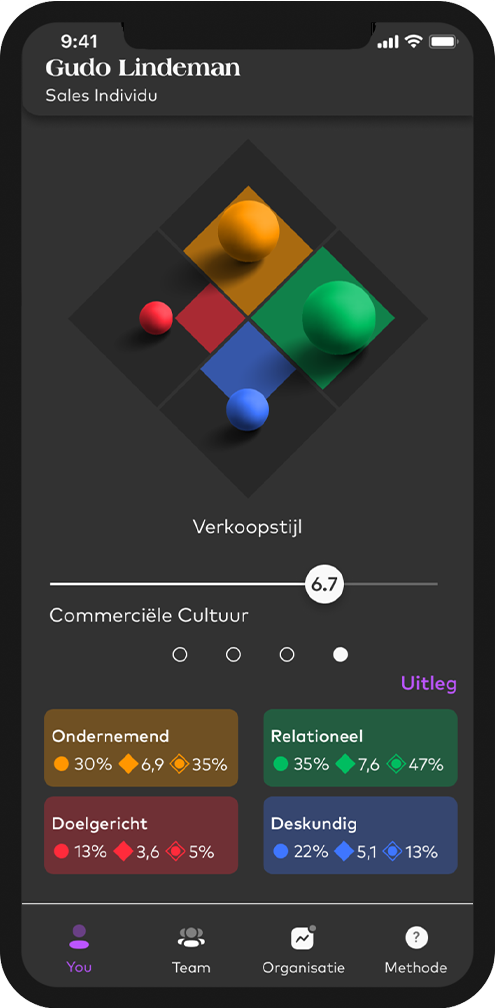
Start your journey today to become a business friend and discover the power of meaningful business relationships. You can do this with the help of the Sales Colors test. You and your sales team can quickly get a picture of your commercial talents and measure how they match with your organization's commercial strategy.

Send via this link a WhatsApp message and indicate how many people you would like to take the Sales Colors test for.

business friend, closer, subject matter expert, hunter, take the ssales colors test, assessment for your sales team, grow in sales through insight, measure your sales team's skills

Sales tips in your mailbox for free

Want to know how to grow in sales? Leave your details and receive our newsletter several times a year with interesting articles and tips.
Newsletter subscription

Successfully deal with the standard text message response in acquisition!

How do you deal with standard SMS response?

Tips for salespeople to remain successful in challenging situations

You call potential customers and receive a standard SMS response. You have prepared yourself as a salesperson for this acquisition moment and are ready for any challenge. You have a plan of action on paper and get to work in good spirits. Yet a standard text message response remains a challenge for many salespeople. How do you handle this without coming across as pushy, while remaining effective? In this article, I offer you insights and practical tips.

A common obstacle is the standard text message response: "I'll call back in a minute." While this can be a convenient way for prospects to save time, it sometimes leaves salespeople uncertain. Here are some ways to deal with this:

1. Take the message seriously

When a prospect indicates to call back, give them time and space to do so. Immediate re-contact may be perceived as intrusive. Wait at least 24 hours before taking any follow-up action.

2. Send confirmation

Respond to the message with a friendly and professional text message. For example, "Thanks for the response! Please let me know when it's convenient for you to call. I look forward to it." This confirms the interaction and keeps communication open without pressure.

3. Schedule a follow-up moment

If the prospect does not call back, contact them again with a specific proposal. For example, "I understand it can be busy. Shall I call you tomorrow around 11 a.m., or would the afternoon be a better fit?" By giving the customer a choice, you offer them a choice and accept their autonomy.

Prospects and customers are like real people

Realize prospects and customers are like real people. When they realize a salesperson is calling their brain tells them, “Beware, responding may lead to a change.” No matter how beautiful and attractive your offer is any change is automatically considered uncomfortable by our brain. Give a prospect a chance to get used to the idea and take them through the change step by step. This starts as early as your first acquisition moment.

Do you also want to deal more successfully with acquisition challenges? Then don't wait any longer and let's uncover them together and look for an appropriate solution.

Make the first change now to become more successful in your acquisition and schedule an appointment to discuss your challenges together directly in my calendar.

none

Training instead of demonstrating

Telephone acquisition can be a powerful way to grow your business and expand your network. With the right approach, you can not only generate new leads, but also build lasting relationships. To achieve this success, the sales team needs the right training and guidance!

Sign up here!

Do you also want to improve your team's performance on acquisition?
Registration training

Personal leadership in sales

What does personal leadership have to do in the world of sales is all about results? Targets need to be met, customers need to be convinced, and competition is lurking. Yet there is one factor that is often overlooked but which makes all the difference between an average salesperson and a true top-performer and that is: personal leadership.

Do you want to stand out from your colleagues or that competitive account manager? Learn the benefits of personal leadership and how it makes a salesperson stand out from the rest.

What is personal leadership?

Personal leadership is about directing yourself. It means taking direction over your thinking, actions and results. You don't wait, you act purposefully. You look critically at yourself, learn continuously and take responsibility for what you can influence. In other words, you are able to reflect and motivate yourself.

In sales, this is not a ‘nice to have’ - it is an absolute must.

The benefits of personal leadership in sales

1. Increased self-confidence and resilience

Rejection is part of the job. But salespeople with self-knowledge don't linger in disappointments. They recover, learn from them and move on stronger. "In what ways can I score the deal next time?"

2. Clear goals and focus

Instead of reactively ‘getting through’ the day, these salespeople actively manage their goals. They have a plan and stick to it. Goal-oriented work gets results!

3. Sincere, authentic communication

Trust is the foundation of every sale. Salespeople with personal leadership dare to be honest and authentic, and therefore come across as credible. No sales talk, but real conversations. Knowing who you are and what you stand for gives confidence and that is essential in the sales conversation.

4. Ownership and results orientation

No excuses, no victimization. This vendor thinks: “What can I do to make this work?” They take responsibility even when the going gets tough. And it is precisely on this last point that the top scorer stands out from the rest.

best salesperson, personal leadership personal leadership gives better sales results growth in sales best salespeople develop

5. Faster personal and professional growth

By continuously reflecting, asking for feedback and developing themselves, they don't get stuck in routine. They learn faster and score better. Just like the elite athlete who looks back at his competition to improve.

Personal leadership is not a ‘soft’ skill; it is a rock-solid success factor.

The difference in practice

Using Chat GPT, I created the diagram below that shows the difference between personal leadership and no personal leadership. You can put check marks for yourself or your sales team in what you recognize. If the result within your account team lags behind the target or if the sales people often miss out on orders in favor of the competition then look honestly which reactions apply.

FeatureWith personal leadershipWithout personal leadership
MindsetGrowth mindset, self-directedStandby, externally oriented
ApproachProactive, structuredReactive, ad hoc
Relationship with customerSincere and advisoryVendor-focused, superficial
Dealing with adversityLearns and adaptsStuck in excuses
Learning capabilityReflects and growsWorks on routine
ResponsibilityTakes ownershipPoints to others

Personal leadership is not a ‘soft’ skill, it is a rock-solid success factor. Salespeople who manage themselves, dare to take an honest look at their approach and take responsibility are the people who not only score today ... but are relevant tomorrow.

Do you want to build a sales organization with more self-direction, energy and results? Then invest in personal development. The impact is immediately visible, in the conversation with the customer and in the end result.

Looking for tools, training or guidance around personal leadership in sales? Take contact on - I'm happy to think with you.

Connecting through good questions

Good questions are the key to influence, insight and impact in any client conversation.

In a series of articles, I will discuss the word "connection" based on each individual letter of this word. In this first part, I discuss the letter V, which stands for asking questions. There are all kinds of sales and communications experts who endorse the importance of asking questions. It is the basis for any conversation to gain insight into the other person. Therefore, it is also essential in getting to know and building a relationship with a customer.

Many book have been published sharing knowledge about the more value of asking questions. Below I share some insights from specialists about asking questions.

Questions provide insight into customer needs

One of the key principles from The 7 Habits of Highly Effective People by Stephen Covey reads:

“Seek first to understand, then to be understood.”
For salespeople, this is more than a nice quote - it is an essential starting point.

Good salespeople don't immediately focus on their product or service, but start by asking smart, open-ended questions. Why? Because only by really listening and understanding the customer's concerns can you offer a solution that really connects.

seven traits of effective leadership

By asking targeted questions, you gain insight into:

Without this information, you're shooting blanks. With good questions, on the other hand, you get direction, grip and relevance.

Questions give direction and control to the conversation

In any sales conversation, it's tempting to talk - about your offer, your credentials, your benefits. But the most successful salespeople do something else: directing them by asking.

Neil Rackham's well-known SPIN Selling method shows how to use the right sequence to strategically build the conversation. He distinguishes these questions:

By this oepplication instead of sending, you keep control without pushing. You lead the customer to insight and action, naturally.

Build trust and credibility

Trust is the value of every sales call. And how do you build it? Not by persuasion, but by sincere listening and understanding.

Salese experts such as Brian Tracy and Jeb Blount emphasize the importance of curiosity:

“People only buy from you when they feel you understand them.”

Good questions - ones that show you are thinking along, in-depth and not making assumptions - create:

Whoever listens wins trust. And who wins trust gains access to the real decision motives. This is how you nurture trust for this and future contact moments.

Activate the customer's thought process

Sometimes a customer doesn't yet know exactly what he needs - or is thinking in the wrong direction. Good salespeople help customers gain new insights, by asking sharp, confrontational questions.

Therefore, The Challenger Sale's approach is not about following, but about challenging. Not by telling you how to do it, but by asking questions that make you think:

Such an approach opens eyes. They bring urgency to light, and make your offerings relevant at a deeper level.

In sales, you win the conversation not with your mouth, but with your ears. If I summarize these 4 insertions this would be a logical conclusion: effective questions result in successful sales

Excellent salespeople distinguish themselves not only with their speaking, but by asking thoughtful questions. They use them to:


Do you and your team also want to win more by asking the right questions? Then come into action and formulate your request for help in a direct email Whether we schedule an appointment immediately.

Deal effectively with acquisition!

How do you persevere in the face of no hearing?

Tips for salespeople to remain effective in the face of initial rejection

Previously, I shared that acquisition in the world of sales is an essential skill. Getting results requires not only persuasion, but also persistence and empathy. Yet, there are situations in which a potential customer does not respond. Such evasive behavior from a potential customer remains a challenge for any salesperson. How do you handle this without coming across as pushy, while remaining effective? In this article, I offer you insights and practical tips.

The power of perseverance

As a salesperson, being persistent without arousing irritation is a delicate balance. When a prospect does not respond, it does not automatically mean disinterest. For example, the timing may not be ideal, the person may be busy, or your message may have simply gotten lost in the daily hustle and bustle. Here are some strategies for persistence:

1. Create a contact strategy

Before you start acquiring, make a plan for how often and at what times you will contact them. A structured approach prevents you from coming across as too pushy. An example might be to make a maximum of three attempts per week: think of an initial phone call, a follow-up email or WhatsApp and a LinkedIn message. Make sure your messages remain short and targeted.

2. Vary in communication

If you always call or repeat the same message over and over, chances are you won't get a response. Alternate with different channels such as e-mail, social media or even a handwritten card. This will show your creativity and keep you in the spotlight in a positive way. The one that stands out stays!

3. Respect silence

If someone does not respond after several attempts, it may be wise to take a break. Pushing the prospect is often counterproductive. Wait a few weeks before contacting again and focus on other leads in the meantime.

A famous quote attributed to Albert Einstein reads, “Madness is doing the same thing over and over again, and then expecting different outcomes.” If you give this phrase a positive spin, as a salesperson, you could approach your acquisition from the following principle, namely, “When you vary your approach, the chances of success increase!”

When you vary your approach, the chances of success increase!

In short you can be effective in your acquisition using a sophisticated strategy, variety in your communication and respect your prospect's known and unspoken desires.

Learn more about effective acquisition management contact us at WhatsApp.

Individual attention through powerful 'Personal Sales Coaching'

The SalesCenter launches innovative 'personal sales coaching.


The SalesCenter is proud to announce a new and powerful form of 'personal sales coaching' to. Specially designed to support salespeople who lag behind in results and take their performance to the next level. Too often commercial managers have too little time to get a sales employee to the desired level. This coaching project changes that.

With this program, a commercial manager makes a targeted investment in the existing sales team. By personally developing a salesperson with disappointing results, he avoids the challenges and costs of recruitment in a tight labor market. After all, the question is who do you bring in at what price with what skills?.


Effective approach for better results

This unique coaching method offers a combination of individual coaching, topical focus and strategic alignment. Each participant starts with a Sales Colors Assessment, identifying specific development areas. This is followed by a 1.5-hour online session every other week in which practical sales skills are trained. These include acquisition, call management, relationship management and successfully closing deals.
Why choose personal coaching?
By participating in this program, salespeople develop essential skills that lead to:

personal sales coaching, improve salesperson, grow in sales, improve your sales results

Growth in results by investing in the development of personal commercial skills.

The program also provides input to sales leadership so that day-to-day coaching is a perfect fit. The program lasts a minimum of three months per participant and can be flexibly extended. With this, a sales manager takes an important step toward a stronger and more successful sales team.

Discover the possibilities


Wondering how the SalesCenter can help your team excel? Contact us today contact up and take advantage of this innovative approach. Thanks to this powerful form of personal sales coaching, together we ensure lasting growth and commercial success!

Leadership and Collaboration

Receive new insights through the valuable input evening at Rock Base

Leadership and collaboration are two elements that are strongly linked. Rock Base, the collaborative label of Peter de Wit and Anthon Geersing, is proud to announce their upcoming interactive evening on this theme. Dedicated to strengthening personal leadership and effective collaboration, this evening offers a unique opportunity to learn from the combined expertise of these two visionaries.

After the first official announcement three weeks ago, in which Peter and Anthon announced "we are going to do something new!", now comes the unveiling of their mission: bringing together the worlds of the Marine Corps and business. By combining the powerful lessons from both fields, they are creating a solid foundation for personal and professional growth.

Expertise

Peter de Wit has an impressive background in the Marine Corps. He will share about his experiences in Afghanistan and Somalia. In doing so, he will provide insights valuable for everyday life and the workplace. Anthon Geersing had a career in sales and management within top 10 automotive organizations. Through his expertise as a trainer and coach at The SalesCentrum, he brings practical and theoretical knowledge. The focus is on the areas of sales, communication and leadership. Together, they give the evening's participants essential input that gives direction to life!

Peter de Wit, Anthon Geersing, Leadership and collaboration

You can be there!

On Thursday evening, January 30, attendees will be taken through an interactive evening at the Eemlandhoeve in Bunschoten Spakenburg. During this evening everyone will receive valuable input that is immediately applicable to grow in leadership and cooperation. The evening promises to be an inspiring and educational experience in which stories will be shared. In addition, one will receive practical tools and insights to make a difference.

Don't miss this unique opportunity to grow personally and learn from the best in their field.

Save the Date

Save the date because on Thursday evening, January 30, we are going to inspire you.

Us, Peter de Wit and Anthon Geersing, are going to bring together 2 worlds. The Marine Corps and the business community. Peter served in the Corps for many years and gained a lot of experience. From training, missions to training recruits. The lessons learned from that are also valuable in business. That's why Anthon makes the connection to your everyday practice on this evening. You don't want to miss this because save the date!

On Jan. 30, you will gain valuable input in the areas of leadership and collaboration. What is your role in the whole and how can you increase your influence in your environment? What is the effect of acting under great pressure? These are some of the questions that will be addressed.

So central is collaboration and leadership. Those two elements are clearly linked. Without good leadership, the team will not experience a need to work together. The role of the leader, in addition to serving as an example, is to inspire the team. Furthermore, within a team one will have to have an eye for the qualities present and use them appropriately. Feedback and good communication are key!

Why save the date? You'll be inspired by true stories. At the same time, you'll get valuable practical input that you can apply immediately. And you will be directly challenged on January 30.

Ticket sales start in January. If you have questions for Peter or Anthon before then send a message via the contact form!