Nice and loose

Loosen up. A comment that an athletic trainer or personal coach will make to motivate you to loosen up your muscles before or after an athletic effort. It is a fact that supple relaxed muscles are better able to handle a power effort.

Loosening up is also essential for an account manager or salesperson. In this case, my concern is not so much with the muscles but more with the thinking. If he is stuck in his thinking, the salesman forms an internal mental block. That stuckness will have its effect in the customer contact. The salesman is rigid in his approach, too focused on performance and too incapable of offering a solution to the customer's problem. This behavior will eventually be noticeable in the bottom line. Sales are disappointing and the foundation for a downward spiral has been formed. Because the salesperson is stuck in their thinking, they will not be able to turn the tide independently.

If you make an exercise effort and think the weight is too heavy to lift again, your thinking will be confirmed. You will not get the weight lifted. Mindset is everything. So too in sales. If the salesperson thinks his customer will not buy this will become the result of the effort. What you think expresses itself in your actions. It is therefore important that a salesman or woman enters a sales meeting with confidence. Customers prefer to do business with someone who is confident in his actions. Because the salesperson's self-confidence helps the customer in his decision-making process.

My name is Anthon Geersing. With my blog I want to inspire everyone dealing with sales. I will share personal experiences and insights gained.

Is there a topic you would like to see featured in one of my blogs share it with me via a WhatsApp message.

A personal trainer will motivate you to do one more set while you have already made an effort. He expresses confidence and influences your thinking by shouting, “you can do it!” The sales profession sometimes seems to be an individualistic profession. The account manager is out on his own, stepping independently into the premises of a potential client. Yet this ‘lone salesperson’ needs a motivating voice. A colleague or commercial manager who calls out, “you can do it, if anyone can close the deal it's you!”. The external source of motivation stimulates the salesperson to do what he perhaps did not know he was capable of doing.

Sales Sales manager Account manager Sales leader Leadership Sales manager Manager Commercial communication Commercial director Acquisition Sales team Lead Lead Lead generation Customer finder Customer binder Sales team Effective Success Sales plan Sales strategy SalesStrategy Training Training Sales training Development Development Growth Talent Explore me Self-innovation Alliances Forming Alliances Showing guts Connecting Thought leadership Amersfoort Sales growth

An external motivating source encourages the salesperson to do that which he did not yet know he was capable of doing.

By having an open mindset and keeping the thoughts loose, by avoiding internal blockages in one's own thinking or by positive words from a colleague, a salesman or woman has an important starting point for success at hand.

I myself think back positively to colleagues or managers who motivated me at times when I was feeling down. Who offered a solution I hadn't thought of yet. Or challenged me to approach a situation with a different mindset. It helped me pick up the thread or achieve a result that I did not know I was capable of beforehand.

By regularly sharing my experiences and writing down insights regarding sales, I want to inspire you. I challenge you to let go of your stuck thinking. Take from my input what you can apply in your sales process! I wish it gives you the building blocks to make that special sales effort.

Be inspired with regularity!

Want to be among the first to receive my blog on sales? 
Then register now below!
Newsletter subscription

Training instead of demonstrating

I often get the question during a training session, "can you show me.".

I often see the following happen.
People who can perfectly imitate what they have been taught...., but get stuck as soon as the situation is just a little different.

And that is exactly why I believe so strongly in real training.

You can show someone everything. In detail. Just like a navigation system, after you enter your destination, it takes you step by step to your destination. Mist you stick to the prescribed route.

But fair?
Then you reached the destination but you didn't learn the way. Next time, you again depend on your navigation system to arrive properly.

Learning and development

For me, learning works differently.

I think of good training as an itinerary on a piece of paper. On it are the most important points:

That route gives direction but leaves room.
Space for self-discovery.
Space to think about choices.
Space to learn the way.

A moment that for me sums up everything

At the start of a new training we did a round of introductions. One of the participants said very openly:

“I've had this kind of training so many times.
I don't actually understand why I'm here.”

I sincerely thanked her for her honesty. And I invited her to take the training from her expertise.

“If you have knowledge or experience that is valuable to the group,
share those above all.”

Not defensive. Not convincing. But with space and confidence.

Later that morning, a question came from the group. A participant kept running into the same situation when interacting with another person and was visibly frustrated.
No matter what he tried, it didn't work.

I deliberately put the question to the participant who had previously indicated he already knew everything.

The solution she offered was logical ..., but not helpful to the questioner.
“I already tried that,” he said.” he indicated. “And it has no effect.”

And that's exactly where the learning point arose.

Learning to choose instead of repeating

I used this moment to explain Stephen Covey's Circle of Influence and Engagement. Not to transmit theory, but to open a different perspective.

I showed that you do not increase your influence on another person by continuing to do what you always did, but by consciously choosing how you enter the contact.

If option one doesn't work, then it requires a different choice. A different approach.

For several participants, including those who already knew everything, this was a new insight. We discussed examples. We explored alternatives. And then we put the brought in case back to the group with one question:

What other choice can you make?

The effect

Some time later I received a call. By the participant who had said at the start that she already knew everything.

She told me that after the training she made a conscious decision to actively apply what she had learned. That she stepped differently in contact with others and approached difficult situations from a new perspective. She experienced the effect and had increased her influence. I was thrilled to hear that it had brought her a lot in the meantime.

That, to me, is what training is about.

Not knowing about it,
but about choosing.
Not about sending,
but about discovery.

The trainer as backup, not helmsman

This is how I work.

You drive yourself, I watch.
I ask questions, and you make choices.

And when the route feels familiar and you can travel it naturally, yourself go on your way. And after some time, this question follows:

What is the next path we can take?

Because when routes are familiar you don't learn anything new. In contrast, when you explore new routes you gain new experience and knowledge.

My approach

At the SalesCenter is not about tricks or standard solutions.
Bottom Line:

In this way, you avoid snapshot and lay the pathway for permanent impact.

Why people choose me:

✔️ Personalized and safe learning environment

✔️ Immediately applicable in your own practice

✔️ Room for experience and new insights

✔️ More influence through better choices

✔️ Trainer as sparring partner

✔️ Growth that stays, even after training

Anthon Geersing Sales trainer, make a sales team topper, grow in sales, sales in Amersfoort, zzp training in sales, mkb sales training

Do you also want to stop what gets in the way of results and get started on what makes a difference on your route?

If so, I'd be happy to go out for a bit with you.

Send me a WhatsApp message with your challenge and let's see together how to find another route in that.

Now on the road together

Schedule an appointment directly in my calendar here
Making an appointment

Push a little?

 ‘Dad, will you push me? In the playground, my son chose his favorite piece of playground equipment, the swing. Pushing, I was somewhat surprised, ’Hey guy you can swing by yourself can't you? As a matter of fact, at home we have a swing hanging there and sir just sits on it for 15 minutes 2-3 times a day without me having to push. In other words, he has mastered the technique just fine, so why the question?

Until the moment he sat on the swing and I started pushing I kept wondering about his demand. He can swing so maybe he just wants companionship. After the first push I understood his question better. The swing at the playground did not move as smoothly as the familiar swing at home. The suspension system and chains felt heavy and seemed to inhibit rather than encourage the initiated movement. To experience the same swing without having to work extremely hard required help.

pushing in sales, how do I help my sales team, sales colors provides insight, what does it take to build a good sales team?

As I was pushing like this, my thoughts went to the field of work. It struck me that tremendous symbolism was unfolding before me. For how is it that a well adept employee yet asks for help in an area familiar to him?

The mistake I myself as a manager sometimes made in the past was that I unconsciously or conveniently applied copy-paste to my team. We have a situation with a client. Earlier we had a similar challenge with another customer so now the colleague can solve the case and bring it to a successful conclusion. What I found important in this was expressing confidence in my colleague's quality and skills. He was bound to succeed again. At the same time, I was selling him or the case short by not taking changing circumstances into account. Reasons that made it less easy to get or keep a case moving I did not take into account.

How is it that a well adept employee still asks for help in an area seemingly familiar to him?

Now it is also partly the responsibility of an employee to ask for help if necessary when a case is heavier. My son did this too! Because of a previous visit to this playground he knew the challenge of the swing in question. So if we as managers keep looking at the surface we may miss essential points. And before we know it we blame this on lack of skills or commitment of the employee in question. a simple question can prevent this.

The sales profession

Let me further substantiate this with an example from the sales profession. You can expect an account manager to be able to build a relationship with a potential customer. Based on a relationship of trust, the account manager takes the steps for a future order. It seems logical that the account manager should do everything possible to nurture the relationship until there is actually an order. If one customer has someone independently empowered and another has a DMU active, the circumstances are of a different order. The direct influence by the account manager on the former situation is different from the latter. It is therefore essential for a commercial manager to see the total picture of the different customers. At the same time, he needs to know what qualities his employees have to move the case.

When my son is bigger and stronger he will have less trouble with the swing in the playground. He is developing. It is important for a commercial manager to form a picture of the qualities of the employees. That way he can better place or prevent in advance a request for help with new circumstances or customers.

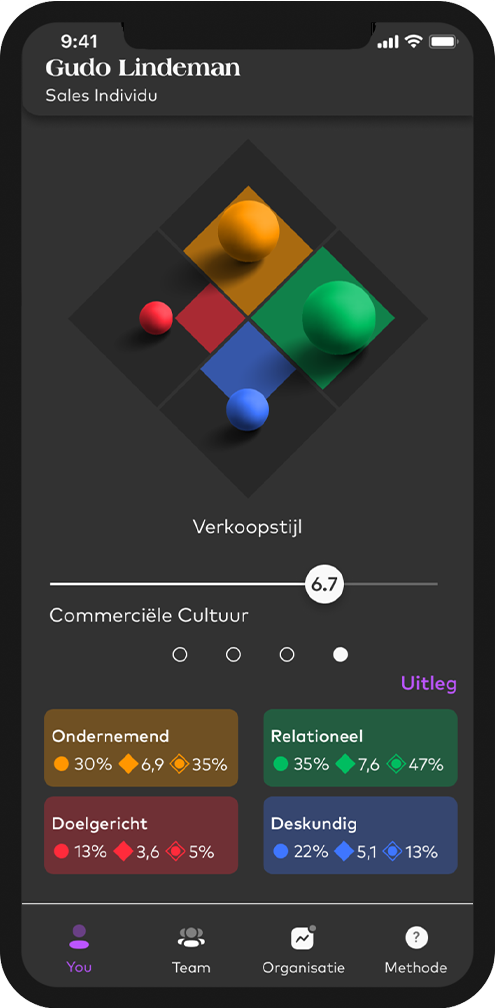
It's possible to gain insight into whether and when you need to help push an employee on your sales team. You get that insight by using the Sales Colors  assessment. This will help you identify which skills are present in your sales team and which can be further developed to keep the order swing moving smoothly.

Sales tips in your mailbox for free

Do you want to improve in your sales yourself or grow as a leader?
Please share your details below for further contact.
Newsletter subscription

How do I become a subject matter expert?

The essential characteristics of a subject matter expert in salespeople and account managers

At a time when competition is fiercer than ever, and customers are increasingly demanding, being a subject matter expert in your field can make all the difference. But what exactly does it mean to be a subject matter expert? And how do you build that expertise? In this article, I discuss what you need to develop into an outstanding professional, with a focus on sales and account management. In doing so, I focus on five core qualities based on Sales Colors. These essential skills are: market knowledge, responsibility, organizational ability, analytical thinking and reliability.

What is a subject matter expert?

A subject matter expert is someone who has in-depth knowledge and skills in a specific field. It is not just knowledge, but also insight, experience and the ability to solve complex problems for clients.

Leadership, direction of your team, leadership styles

For a salesperson or account manager, this means not only knowing your products or services inside out, but also understanding what your customer needs. You understand the dynamics of the market and can think strategically.

The essential characteristics of a subject matter expert:

1. Market Knowledge

To be a subject matter expert, market knowledge is crucial. This means that you not only follow trends and developments, but also understand how they affect your customers' needs. For you, this means that you:

  • The competition knows and knows what they offer.
  • Understand the needs and challenges of your customer segment.
  • Able to translate trends into opportunities for your organization.
declining sales, prevent a decline in sales, strategy, sales year, sales decline, tips and strategies against sales decline

The better your knowledge, the more valuable you become to your clients and organization.

2. Responsibility

As a subject matter expert, you bear responsibility for your work and results. This means you take ownership of your projects, clients and goals. For a salesperson and account manager, this means:

Showing responsibility not only increases customer trust but also strengthens your credibility within the team.

3. Organizational Ability

A subject matter expert knows the importance of being well organized. This may include the following:

A structured way of working ensures that you are more productive and better able to take your customer service and sales performance to the next level.

4. Analytical thinking

A subject matter expert can analyze complex situations and find solutions that add value. For a salesperson or account manager, this means:

Analytical skills help you to be not only reactive but also proactive, allowing you to be more responsive to the needs of your customers.

As an experienced subject matter expert, you will build greater success, stronger relationships and an impressive reputation in your field.

5. Reliability

Reliability is one of the most important traits of a subject matter expert. Clients, colleagues and supervisors must be able to rely on you. This means:

Reliability builds strong relationships, which is essential in sales and account management. It creates customer loyalty and strengthens your position within the organization.

How do you develop these characteristics?

Developing these characteristics requires dedication and a constant focus on self-improvement. Here are some steps you can take:

Becoming a subject matter expert is not a final destination, but an ongoing journey of learning and growth. For salespeople and account managers, this means embracing and developing the five essential characteristics - market knowledge, responsibility, organizational ability, analytical thinking and reliability. The result? Greater success, stronger relationships and an impressive reputation in your field.

Do you want to excel? Start your journey as a subject matter expert today. You can do this with the help of the Sales Colors test. You and your sales team can quickly get a picture of your commercial talents and measure how they match with your organization's commercial strategy.

Send via this link a WhatsApp message and indicate how many people you would like to take the Sales Colors test for.

The right mindset when making acquisitions: tips for successful and positive calling

The right mindset in acquisition is the key to success.It is essential how you approach new clients positively, motivated and effectively.

Yet making acquisitions is a mental challenge for many salespeople. Maybe the marketing department has come up with a promotion that forces you to make calls. Or maybe you find yourself not wanting to depend entirely on incoming leads. Being active in sales is a must, and that includes acquisition.

Keeping existing clients warm and enthusing new potential clients are crucial parts of your job. But especially the latter - cold acquisition - is often difficult. Because who is really waiting for your phone call?

Dealing with rejections, silence or vague responses can be frustrating. Yet it is possible to do acquisition with a positive mindset. In this article, you'll discover practical tips for staying motivated and achieving greater success while making calls.

Why making acquisitions is often a challenge

By approaching acquisition with the right mindset, you make this process not only more effective but also more fun.

The right mindset in acquisition

1. See every interaction as an opportunity

Even a short phone call or a standard text message response is an opportunity to improve your message or build a relationship. Use the feedback you get to refine your approach.
As in the article Deal effectively with acquisition! is emphasized: “When you add variety to your approach, the likelihood of success increases.” You cannot change your client, but you can change your own behavior and approach.

2. Always remain professional

Even if a prospect never responds, it is important to remain professional and respectful. You never know if that same person will still show interest or recommend you to others in the future.
Avoid expressing disappointment in your emails, messages or conversations.

3. Focus on long-term relationships

Sales is not just about quick deals, but more importantly about trust and relationships. Through a consistent, polite and empathetic approach, you build a reputation that opens doors.
Consider:

In this way, you nurture the balance of trust - an essential starting point for a lasting business relationship.

When you vary your approach, the chances of success increase

How do you stay positive during calls?

  • Prepare well: Create a call script, but stay flexible.
  • Set a goal per conversation: that doesn't always have to be an appointment, it can also be getting information.
  • Celebrate small successes: every good interaction gets you closer to a deal.
  • Keep learning: Evaluate conversations and improve your approach each time.
make acquisitions, cold acquisition, mindset in acquisition, positive mindset during acquisition, positive calling, successful calling for sales, dealing with rejection in acquisition, acquire customers, call prospects, make sales calls, build valuable connections

Conclusion: making acquisition more fun and successful

Acquisition is a process that requires patience, creativity and perseverance. Dealing with no hearing and default responses is challenging, but with the right strategies and mindset, you can approach this process positively.

By focusing on persistence, respect and relationship building, you not only increase your chances of success, but also strengthen your professional reputation.

Remember: every interaction is one step closer to a valuable connection.

Ready to make acquisition more fun?

Want more tips on how to build really valuable connections in addition to acquisition?
Send me a email or WhatsApp message and schedule a free introductory consultation right away.

Also improving in acquisition?

Schedule an appointment directly in my calendar here
Making an appointment

Becoming a business friend: the commercial skills to build lasting relationships

If you have the traits of a business friend, you have important commercial skills that will make a difference in the long run.

Building business relationships is an art that goes beyond simply selling. A true business friend, as many call it, is not only a salesperson but also a trusted partner who guides, supports and inspires customers. In this article, we will take a closer look at how to become such a business friend and what commercial skills are essential to do so.

What is a business friend?

A business friend is more than a salesperson; this person puts the customer first and strives for a long-term relationship based on trust and mutual understanding. This type of salesperson understands the customer's needs and actively seeks solutions that add real value, rather than just offering products and services. This involves a combination of commercial acumen and empathy, which creates a solid foundation for a lasting partnership.

Essential commercial skills

To become a successful business friend, there are five core skills you must master. These are the foundation of a customer-centric and effective approach.

Customer Focus

Customer focus is the foundation of any business relationship. To be a business friend, you must not only understand the customer's needs and wants, but also anticipate what that person needs. Listening plays a crucial role in this. Ask pointed questions and show genuine interest in the client's challenges and aspirations. By placing your focus on delivering solutions that align with their goals, you create satisfaction and trust.

Self-Knowledge

Self-knowledge is an important and often underrated skill. The ability to recognize your own strengths and weaknesses enables you to communicate authentically and effectively. Reflect regularly on your performance and ask yourself how you can improve yourself. For example, are you good at persuasion but less skilled at listening? If so, work on strengthening your listening skills. Someone with the skills of business friend is always engaged in personal growth and uses that knowledge to become better at helping clients.

Collaborate

Collaboration is essential, not only within a team but also with clients. Building a partnership requires being open to input from others and being willing to look for solutions together. A business friend understands that success depends on internal collaboration as well as external partners. By ensuring transparency and respectful communication, you create an environment where collaboration flourishes.

Involvement

Engagement means that you are fully committed to your client's success. This goes beyond just executing transactions; you are a partner in their growth and development. Show that your commitment does not depend on the size of the deal, but on the value you add. A proactive attitude and checking in with the client regularly shows that you care about them and take their goals seriously.

Team Building

Although team building is often associated with internal collaboration, it can also play a role in your relationships with clients. As a business friend, you are a bridge builder, bringing different people and expertise together to create the best solutions. Think about coordinating internal teams or connecting external partners with customers. By using this skill, you increase the chances of success for everyone involved.

Tips for becoming a business friend

In addition to developing the above skills, there are some practical strategies that can help you position yourself as a true business friend.

Becoming a business friend requires more than commercial clout; it requires insight, empathy and a willingness to always go the extra mile. By embracing customer focus, self-knowledge, cooperation, commitment and team building, you are well on your way to becoming a reliable partner for your customers. It is an investment that leads not only to business success, but also to personal satisfaction.

The role of the Sales Colors test

Start your journey today to become a business friend and discover the power of meaningful business relationships. You can do this with the help of the Sales Colors test. You and your sales team can quickly get a picture of your commercial talents and measure how they match with your organization's commercial strategy.

Send via this link a WhatsApp message and indicate how many people you would like to take the Sales Colors test for.

business friend, closer, subject matter expert, hunter, take the ssales colors test, assessment for your sales team, grow in sales through insight, measure your sales team's skills

Sales tips in your mailbox for free

Want to know how to grow in sales? Leave your details and receive our newsletter several times a year with interesting articles and tips.
Newsletter subscription

Showing connection through enthusiasm

By showing enthusiasm in the sales conversation, you will achieve more with your customer.

In a series of articles, I will discuss the word "connection" in terms of each individual letter. In this first part, I covered the letter V, which stands for asking questions. Now the letter E which stands for showing enthusiasm.

Why is enthusiasm essential in any sales conversation?

In the world of sales, it is no longer just about arguments, specifications or competitive prices. What really makes the difference? Sincere enthusiasm. Not played, not exaggerated, but real! Because who believes in his product and is happy with the contact with the customer, not only sells more... he also builds relationships that last. And thus, from his enthusiasm in the first sales conversation, the salesman builds a bridge to future orders.

Enthusiasm: the key to confidence

Imagine two salespeople selling the exact same product. One does it dutifully and measured words, the other talks with fire and visibly believes in what he is offering. Who wins? Always the second.

Sincere enthusiasm exudes confidence. You thus influence the thinking of your customers. “If he believes in it like that, then it's worth it.” It makes your story believable, human and compelling.

Enthusiasm makes the message come alive

An enthusiastic sales pitch is not a standard rant. It is a lively, energetic conversation in which you:

After all, people rarely buy on pure logic. They buy by feeling, and enthusiasm is the fuel of that feeling.

Enthusiasm for the customer himself

It's not just the product that counts; it's the personal contact with the customer that deserves enthusiasm. A salesperson who enjoys the conversation shows:

Through a personal approach you build trust. Through your questions you open the other person and give space for their needs, questions and doubts. With this you build a relationship.

How do you make sure that enthusiasm is real?

Years back there was a commercial in which a car salesman paid attention to the customer's children in a very contrived way with the legendary words, “what nice children.” An obligatory number which expressed the so-called interest in the customer. Say: “everything for the order”. It should be clear that enthusiasm should really feel otherwise it is counterproductive.

A few tips to get that done:

  1. Know your product inside out. Be proud of what you sell by being able to name distinctive details, for example. Find what you personally think is good or clever about it.
  2. Focus on helping the customer, not on closing the deal. Put yourself in the customer's problem so you can connect with your product or service from that recognition.
  3. Use your own words. So no slick sales pitches, but human language.
  4. Tell real-life stories. This can see your own experience or just that of another client. By doing so, you show that it works or provides the desired solution.
  5. Let your body language align with your words. Stand or sit up straight, speak with energy and emphasize things with a gesture.
  6. Stay relaxed. Enthusiasm is not pressure, but a natural conviction. When you are convinced and genuine, the client experiences it that way.

Enthusiasm works both ways

When you are enthusiastic, you feel better, too. You gain energy, self-confidence and pleasure in your work. Clients notice that and you notice it in your results. Once a male client whispered to his wife, "Don't be so positive, dear, that will cost us money. My response was, please be enthusiastic lady because it is much nicer doing business with people who really feel like it. That applied to me as a salesman and that is also true from the salesman towards the customer.

People don't buy products, they buy energy!

In short, people buy not only what you sell, but especially how you convey it. So show that you feel like it. That you believe in what you do. And that you value your customer. Because sincere, warm, energetic salespeople make an impression and close orders more successfully.

none

Nice and loose

Do you also want a team with enthusiastic salespeople?
Let's see together what your needs are. We train with customized solutions. 

Sign up here!

Enthusiasm starts here!
Registration training

Beat competition in the summer!

How do you differentiate yourself from your competition in the summer?

Standing out from competitors and summer rest, do they go hand in hand? Summer is the perfect time to recharge your batteries. Vitamin D, socializing with family and friends and sometimes just doing nothing at all. Just empty the agenda and no obligations. Refuel!

No matter how empty the agenda, we cannot disconnect our heads from who we are and what we do. Deals we are (have been) active in resonate after. If you are an entrepreneur or commercial manager operating in a competitive market, deals in which you had to go to the limit may come up for review. What did I do well, where could I have done things differently, where did I miss opportunities and how can I be eager next time without coming across as a beggar?.

Especially during the summer period, you can use the empty schedule to make a difference on your next competition. Consider a number of things:

During summer rest, your mental and physical energy recovers

    Because of the sun, we literally receive energy in our bodies. We need this to perform optimally. Our bodies benefit from this. At the same time, we are detached from targets and deadlines during summer vacation. Less stressful conditions are beneficial. This has been scientifically proven. As we relax, our mind rests and we can apply better focus. This sharp mind can be put to use again in the next battle with your competitor.

    Time for reflection.

      The deals, the competitive battle and or the missed orders you can run them through your mind.‘What went well and what influence did I have on that?' 'What opportunities did you miss and how could I have made different choices in this?’

      You can take the lessons from this into the second semester. What will the goals be and how can you achieve them more effectively? It is precisely because you are detached from the issues of the day that you see opportunities that you did not see during your busy schedule. And because your mind is at rest, creative opportunities arise to turn the next battle with your competitor into your advantage.

      Build relationships

      At the beginning of the summer period many networking clubs are active with a summer drink or BBQ. During the period of more freedom in your calendar, check for yourself who you spoke to at this last event, or think about who I didn't speak to at all when it would have made sense. Find contact with people who inspire you and challenge you to think out-of-the-box. Also look at the network of your contacts. Who within their network can they connect you with?

      During vacations, you often meet like-minded people. Learn from them and how they operate. Be genuinely curious and ask questions about how they are successful. It is precisely through others that you can be inspired and come up with an idea that can be distinctive so that next time the customer chooses you instead of your biggest competition.

      Famed American football player TomBrady said the following about translating mental strength to competition:

      Competition, defeating competitors, better than your competitor, mental strength

      “Every quarterback can throw a ball; every running back can run; every receiver is fast; but that mental toughness ... translates into competitiveness.”

      Mental clout is a choice. You have the opportunity to get a head start just in the summer by taking mental rest, sharpening your mind and being inspired by others for distinctive ideas.

      In short, during the summer period you can mentally unload and refill yourself with energy and ideas that will allow you to be one step ahead of the competition.

      How do I become a hunter?

      The road to success as a commercial talent

      Being a “hunter” is a challenging but rewarding role within the commercial world. Hunters are commercially driven people with a clear focus on acquiring new customers, opening doors and creating opportunities where others do not see them. This role requires specific skills, traits and an unwavering drive to win. In this article, I'll take you through what it means to be a hunter and what commercial skills you need to become successful.

      What makes a hunter unique?

      A hunter is distinguished by a strong focus on delivering. These commercial talents are actively exploring and capturing new markets. It requires a combination of determination, strategic thinking and unstoppable ambition.

      The commercial skills a hunter needs

      To become a successful hunter, specific personal and professional skills are essential. Here are the most important traits:

      Ambition

      Ambition is what drives their success. As a hunter, you must have a clear vision of where you want to go and be willing to work hard to achieve those goals. Ambitious hunters constantly set themselves new challenges and do not get discouraged by obstacles. They are determined and focused on the finish line.

      Driven

      Drive is an indispensable trait in the life of a hunter. This role requires someone who is not afraid to step outside the box and takes every opportunity to move themselves and the company they work for forward. Individuals who stand out in this area are often the first to get started and the last to quit because they feel a passion for getting results.

      Entrepreneurial

      A hunter is entrepreneurial and sees opportunities before others recognize them. This trait is accompanied by a proactive attitude and the ability to make quick decisions. Enterprising hunters are not afraid to take risks and have the courage to try new strategies. They are also adept at predicting trends and adapting to changing market conditions.

      Creative

      Creativity is an essential trait for a hunter. The ability to think creatively and find innovative solutions can make the difference between a closed deal and a missed opportunity. Hunters must be able to stand out from the competition by presenting original ideas and offering customized solutions that specifically meet the client's needs.

      Presenting

      A hunter can present themselves like no other. Effective communication is the key to persuading potential clients. Hunters are confident and charismatic. They are able to convey complex information simply and leave a lasting impression. The ability to give a powerful pitch and convey their message clearly and convincingly is crucial in capturing new clients.

      How to become ahunter in sales, How to get more success in sales, What sales skills are important for success, Growing in sales,

      Becoming a hunter requires ambition, drive, entrepreneurship, creativity and excellent presentation skills.

      How do you develop yourself as a hunter?

      The path to success as a hunter begins with developing the above skills. Here are some practical tips for improving yourself:

      Becoming a hunter requires ambition, drive, entrepreneurship, creativity and excellent presentation skills. It is a role that requires a lot of commitment, but also offers tremendous rewards for those willing to give it their all. By focusing on self-development and perseverance, you can position yourself as a successful hunter and an indispensable force within your industry.

      If you want to discover to what extent you possess the skills of the hunter, do now the Sales Colors test. You and your sales team can quickly get a picture of your commercial talents and measure how they match with your organization's commercial strategy.

      Please send an WhatsApp message and indicate how many people you would like to take the Sales Colors test for.

      Successfully deal with the standard text message response in acquisition!

      How do you deal with standard SMS response?

      Tips for salespeople to remain successful in challenging situations

      You call potential customers and receive a standard SMS response. You have prepared yourself as a salesperson for this acquisition moment and are ready for any challenge. You have a plan of action on paper and get to work in good spirits. Yet a standard text message response remains a challenge for many salespeople. How do you handle this without coming across as pushy, while remaining effective? In this article, I offer you insights and practical tips.

      A common obstacle is the standard text message response: "I'll call back in a minute." While this can be a convenient way for prospects to save time, it sometimes leaves salespeople uncertain. Here are some ways to deal with this:

      1. Take the message seriously

      When a prospect indicates to call back, give them time and space to do so. Immediate re-contact may be perceived as intrusive. Wait at least 24 hours before taking any follow-up action.

      2. Send confirmation

      Respond to the message with a friendly and professional text message. For example, "Thanks for the response! Please let me know when it's convenient for you to call. I look forward to it." This confirms the interaction and keeps communication open without pressure.

      3. Schedule a follow-up moment

      If the prospect does not call back, contact them again with a specific proposal. For example, "I understand it can be busy. Shall I call you tomorrow around 11 a.m., or would the afternoon be a better fit?" By giving the customer a choice, you offer them a choice and accept their autonomy.

      Prospects and customers are like real people

      Realize prospects and customers are like real people. When they realize a salesperson is calling their brain tells them, “Beware, responding may lead to a change.” No matter how beautiful and attractive your offer is any change is automatically considered uncomfortable by our brain. Give a prospect a chance to get used to the idea and take them through the change step by step. This starts as early as your first acquisition moment.

      Do you also want to deal more successfully with acquisition challenges? Then don't wait any longer and let's uncover them together and look for an appropriate solution.

      Make the first change now to become more successful in your acquisition and schedule an appointment to discuss your challenges together directly in my calendar.

      none

      Nice and loose

      Telephone acquisition can be a powerful way to grow your business and expand your network. With the right approach, you can not only generate new leads, but also build lasting relationships. To achieve this success, the sales team needs the right training and guidance!

      Sign up here!

      Do you also want to improve your team's performance on acquisition?
      Registration training